
Posted July 12th, 2010 by surplus
Below is the line-up for this week’s events organized as part of the exhibition Re:Group: Beyond Models of Consensus, which examines participation as a model and models of participation in art and activism. Re:Group proposes that with participation now a dominant paradigm, structuring social interaction, art, activism, the architecture of the city, the internet, and the economy, we are all integrated into participatory structures whether we want to be or not.
The exhibition showcases art/activist work that participates in and subverts existing participatory systems. Hands-on workshops invite audience members to collaborate with the artists, open-sourcing their works and producing new participatory interventions.
Re:Group is curated and organized by Eyebeam, Not An Alternative, and Upgrade NY!. Events are hosted at Eyebeam Art and Technology Center, 540 w. 21st St, between 10th and 11th ave.
WORKSHOP: HACKING SUSTAINABLE FASHION
JULY 14, 7-9PM: What is sustainable fashion? Why are design codes important? How do we decode them? Curator Sarah Scaturro and interaction designer Giana Gonzalez will use these questions as a starting point to work with participants to explore how the code for the sustainable fashion movement can be decoded and reassembled.
The HACKING Couture explorations will be a starting point for this work in progress. In the past, HACKING Couture has reversed engineered fashion labels to create open participation and entrance for all into the fashion system. Now, this process of hacking fashion labels has been expanded - how can we decode a period and/or a movement in order to re-appropriate it for your own purpose? This collaborative workshop between Hacking Couture and independent curator and sustainable fashion expert Sarah Scaturro will explore how we can collaboratively document, decode and reassemble the Eco-fashion movement.

WORKSHOP: MAPPING HOMELESSNESS: AN INTRODUCTION TO USHAHIDI
JULY 15, 2-6PM: With a group of up to 24 people, we will start a map of amenities for homelessness. The session will start with an introduction to the purpose and history of the Ushahidi platform, an open source tool that allows rapid mobile input into a collaborative map and database. After installing and setting up an instance of the Ushahidi platform, we explore the Chelsea neighborhood as a group, photographing and geolocating aspects of the city we would notice if we did not have reliable housing. We will use smartphones (provided) to map places to find work, places to relax in safety, places to get food and shelter, places to take a family, social services. Participants will brainstorm ideas for using Ushahidi in diverse contexts.
PANEL DISCUSSION: ON NETWORKED SOLIDARITY
JULY 15, 7:30PM:Organized and moderated by Mushon Zer-Aviv Discussants: Chris Blow, Ushahidi.com & Meedan.net; Christopher Robbins, WPA 2010 &Ghana Think Tank; and Nadine Wolf, Elecciones Transparentes.com. As we’ve seen in Haiti, networked collaboration enabled geeks to affect disaster relief efforts, a job previously exclusive to governments, NGOs and multinational corporations. Will they stick around after the hype has passed? Is the network actually changing the flow and directionality of global attention? Are we seeing the prospects of a new networked solidarity or is it just another trending topic?
WORKSHOP: USHAHIDI WITH WPA 2010
JULY 16, 11AM: This workshop is part of a series of community action workshops
organized by WPA 2010, bringing back a citizen-driven Works Progress Administration, including action research with the Ushahidi open source digital platform, silkscreening and stenciling, and guerilla public works. As a follow-up to the more traditional paper and pencil workshop that Christopher Robbins ran on July 7, Chris Blow of Ushahidi will join WPA 2010 on July 16 as they hit the streets with the reconstruct crew, 8 google android phones, and the Usahidi platform to collect site data for possible WPA projects in Jamaica, Queens.
Faciliated by Christopher Robbins, WPA; Chris Blow, Ushahidi. WORKSHOP FULL, email stephanie@eyebeam.org to be added to the waitlist.
Posted July 6th, 2010 by surplus

Thursday, July 8, 7:30pm-9pm (free)
Eyebeam Art & Technology Center
540 W 23rd St, btw 10th & 11th
Organized by Not An Alternative, moderated by Astra Taylor
Discussants:
Professor/author Jodi Dean; non-profit organization Not An Alternative; artist John Hawke
Today everyone sings the praises of participation: leading academics hail active audiences who remix commercial culture, established curators wax poetic about relational aesthetics, web 2.0 executives and marketing experts applaud openness and connectivity, conservative economists have discovered the benefits of collaboration. Interactivity, access, engagement are the highest ideals of the new order, ideals taken by many to be synonymous with democracy. Participation is perceived as politics, and vice versa.
The fantasy of participation is a powerful one, postulating, as it does, the invitation and inclusion of everyone, everywhere. The Internet, we are told, makes this dream a reality, erasing borders and distinctions, smoothing out differences and hierarchies. We are all equal now, because we believe everyone’s voice can be heard. Political theorist Jodi Dean calls this “communicative capitalism,” an ideological formation that fetishizes speech, opinion, and participation.
With participation now a dominant paradigm, structuring social interaction, art, activism, the architecture of the city, and the economy, we are all integrated into participatory structures whether we want to be or not. How are artists and activists navigating the participation paradigm, mapping the limits of collaboration, and modeling participatory forms of critical engagement?
The panel is presented in association with the exhibition Re:Group: Beyond Models of Consensus, curated and organized by Eyebeam, Not An Alternative, and Upgrade NY! View the full list of related programing, including panels and workshops.
ABOUT THE PRESENTERS
Astra Taylor is a writer and documentarian. Her films “Zizek!” and “Examined Life” screened in festivals, theaters, on television around the world. She was named one of the 25 New Faces to Watch in independent cinema by Filmmaker Magazine in 2006. Astra has also contributed to Monthly Review, Adbusters, Salon, Alternet, The Nation, Bomb Magazine and other outlets.
Jodi Dean is Professor of Political Science at Hobart and William Smith Colleges and Erasmus Professor of the Humanities in the Faculty of Philosophy at Erasmus University. Her research and writing focus on the contemporary space or possibility of politics. She is the author or editor of nine books, including Zizek’s Politics (2006), Democracy and Other Neoliberal Fantasies (2009), and Blog Theory: Feedback and Capture in the Circuits of Drive (2010).
John Hawke is an artist whose work began in landscape painting—specifically the sited-ness of plein air painting, and has developed to model the landscape not as an optical organization of colors, but as a collection of vectors of interest. He has exhibited throughout the US, as well as in Lisbon, Chichester (UK), Oslo, and Milan. He has presented his work at the New Museum, PS.1, the New School’s Vera List Center, and at the College Art Association (LA, 2009). His current practice involves unauthorized collaborations as urban interventions. His work can be seen in the exhibition, Re:Group: Beyond Models of Consensus.
Not An Alternative is a non-profit organization with a mission to produce, support, and popularize a practice of critically engaged cultural production that integrates art, activism, technology, and theory. The group questions and leverages the tools of advertising, marketing, public relations and spectacle-making, with an aim to affect popular understandings of events, symbols, and history. They are co-curators of the exhibition, Re:Group: Beyond Models of Consensus.
Posted June 9th, 2010 by surplus
Re:Group: Beyond Models of Consensus proposes that with participation now a dominant paradigm, structuring social interaction, art, activism, the architecture of the city, and the economy, we are all integrated into participatory structures whether we want to be or not. The exhibition showcases work that subverts existing systems or envisions new alternatives to the ways in which individuals can take part, or choose not to take part, in social and cultural life.
For the past year Eyebeam and Not An Alternative have organized the NY node of Upgrade!, with the theme Open Source in Activist and Creative Practice. The decision to produce this show was born from that collaboration, however the curatorial concept was a source of constant debate. A unified position was never achieved, but collaboration does not necessarily result in synthesis. The intention with the following two curatorial statements is to reflect subtle but important differences in our curatorial perspectives on the subjects of collaboration and participation. As we reflect back on the process of curating this show we see that our experience was far richer because of the (albeit sometimes painful) philosophical, aesthetic, and political debates among us. While harmonious unanimity was never achieved, in our view this must not be seen as an inevitable goal. We appreciate that in this show about collaboration, our curatorial collaboration has honored distinct positions, rather than subsuming difference in pursuit of consensus.
STATEMENT #1:
These days everyone – individuals, corporations, governments and DIY punks – idealizes participation. Many believe that when horizontal structures of participation replace top-down mechanisms of control, hierarchy and authoritarianism, this will eliminate apathy and disenfranchisement. While we acknowledge that distributed systems are proven and powerful tools for dismantling certain monolithic structures, we question an unalloyed faith in participation. As co-curators of the show we fought the temptation to simply celebrate the subversive potential of networked collaborations. Instead, we sought to critically analyze the contours of this emergent ideology, and to re-evaluate refusal, non-engagement, antagonism, and disagreement as fundamental to a participatory framework.
We are all the time besieged to Participate! Choose! Vote! Share! Join! And Like! And yet, we are all, already, integrated into structures of participation (whether we “like” it or not). We worry that a veneer of engagement only obscures deep flaws in the participation paradigm. Too often, it seems, progressives believe that power operates exclusively from above, that command and control emanate from some centralized, closed authority. It is no wonder that many latch on to notions of openness, transparency, and participation as radical ends in themselves; however we must not fetishize process over product.
Participatory frameworks are not in and of themselves politically significant, nor is power limited to distant and impersonal structures. Power is diffuse and distributed, operating through us and on us; participation therefore can turn into a vector for dominant ideologies as easily as it can liberate.
If participatory frameworks are to have any meaningful political consequence or activist import, they must intervene on some object, to operate in service of an end. Conflict is a necessary result of such collaboration, and a key driving force within it. Current conversations around participation idealize harmony and unison, but we ask whether synthesizing perspectives and valorizing consensus might actually subsume dissenting viewpoints, through the tyranny of compromise and the rule of the lowest common denominator. From this view, we fear a disavowal of power rather than an honest discussion about it.
And so we pass on politesse, and draw a line in the sand. We aren’t interested in raising questions, exploring models of participation or experiments in collaboration. We take a position: that participationism plagues us. More than dismantling or distributing power, we’ve invisibilized and extended it. An intervention is in order, and we offer practices and programming that contribute to this conversation: foregrounding the contours and boundaries inherent in participation, the contradictions and conflicts in a fruitful collaboration.
Read the rest of this entry »
Posted June 8th, 2010 by surplus

Please join Not An Alternative, Eyebeam Art and Technology Center, and Upgrade NY! this Thursday, June 10 for the opening of Re:Group: Beyond Models of Consensus, an exhibition which examines models of participation and participation as a model in art and activism.
Re:Group proposes that with participation now a dominant paradigm, structuring social interaction, art, activism, the architecture of the city, the internet, and the economy, we are all integrated into participatory structures whether we want to be or not. The exhibition showcases work that subverts existing systems or envisions new alternatives to the ways in which individuals can take part, or choose not to take part, in social and cultural life.
Re:Group features work by thirteen artists, designers, hackers, activists, and collectives exploring both the potential and limitations of participation, networked collaboration, and distributed labor. From the “crowdsourced” projects Ten Thousand Cents and White Glove Tracking to the tactical media art of The Yes Men and Ubermorgen, from the urban interventions of John Hawke and The Institute of Infinitely Small Things to the open platforms of Ushahidi and MakerBot - the exhibition represents a diverse range of critically and socially engaged work that rethinks the institutional practices within urban planning, civil engineering, transportation, industrial design and production, relief work, and the news media.
The exhibition not only presents completed work through gallery installations, but also functions as a platform for new collaborative work. Through workshops, master classes, and discussions led by the exhibiting artists, the processes and methodologies behind the work are opened up to gallery visitors and invited communities, providing an opportunity to extend and reinterpret the artists’ ideas in new and unexpected ways.
RE:GROUP: BEYOND MODELS OF CONSENSUS
JUNE 10 - AUGUST 7, 2010
PARTICIPATING ARTISTS
John Ewing, Christopher Robbins & Carmen Montoya - Ghana Think Tank
Giana González - Hacking Couture
John Hawke - Mandatory Minimum: We Have Moved!
The Institute for Infinitely Small Things - Corporate Commands
Aaron Koblin and Takashi Kawashima -Ten Thousand Cents
Steve Lambert and Packard Jennings - Wish You Were Here: Postcards from our awesome future
MakerBot Industries - MakerBot
Christopher Robbins - Work Projects Administration 2010
Evan Roth and Ben Engebreth - White Glove Tracking
Ushahidi - Crisis Map of Haiti
Ubermorgen.com - [V]ote-Auction
The Yes Men - Good Cop 15
YoHa (Yokokoji, Harwood) - Social Telephony
CREDITS
Curated and organized by Eyebeam, Not An Alternative, and Upgrade! NY
Produced and sponsored by Eyebeam
Curatorial team: Paul Amitai, Marco Deseriis, Not An Alternative, Stephanie Pereira, Mushon Zer-Aviv
Exhibition design: Not An Alternative and Paul Amitai
Brochure and environmental graphic design: Not An Alternative
Technical management and installation: Marko Tandefelt
Exhibition installation and construction: Nicholas Fraser, Kory Hellebust, Titania Inglis, Takayuki Ito, Not An Alternative, Jamie O’Shea
Read the rest of this entry »
Posted May 14th, 2010 by surplus

What: Brookyln-based arts group Not An Alternative is one of 70 around the world featured at the Tate Modern’s 10th anniversary show “No Soul for Sale: A Festival of Independents”.
Where: Tate Modern in London
When: May 14-16, 2010
In 1996 artist/architect Rikrit Taravanija built a to-scale replica of his East Village, NY apartment and installed it in a gallery. Entitled “Tomorrow is Another Day” and made with 2×4’s, he invited visitors into his space to watch television, eat dinner, take naps. The lines between life and art were blurred, the walls porous, inside and outside collapsed.
This installation heralded a new era of participatory art, a practice widely celebrated in biennials, galleries and museums around the world. With participation now a dominant paradigm, structuring business models, creative and activist practice, the architecture of the city, the internet, and the economy, we have to ask: what are the limits of participation? Who gets to participate, and who is left out?
In an installation at Tate Modern’s 10th anniversary festival in London, NY-based arts organization Not An Alternative locates these themes within our contemporary historic moment. The piece, entitled “Tomorrow is Another Day (After the Economic Crisis)” shows the façade of a building constructed in 2×4’s, the windows shuttered with plywood, the door padlocked. With a foreclosure sign nailed to the entrance, your participation in the piece is effectively foreclosed.
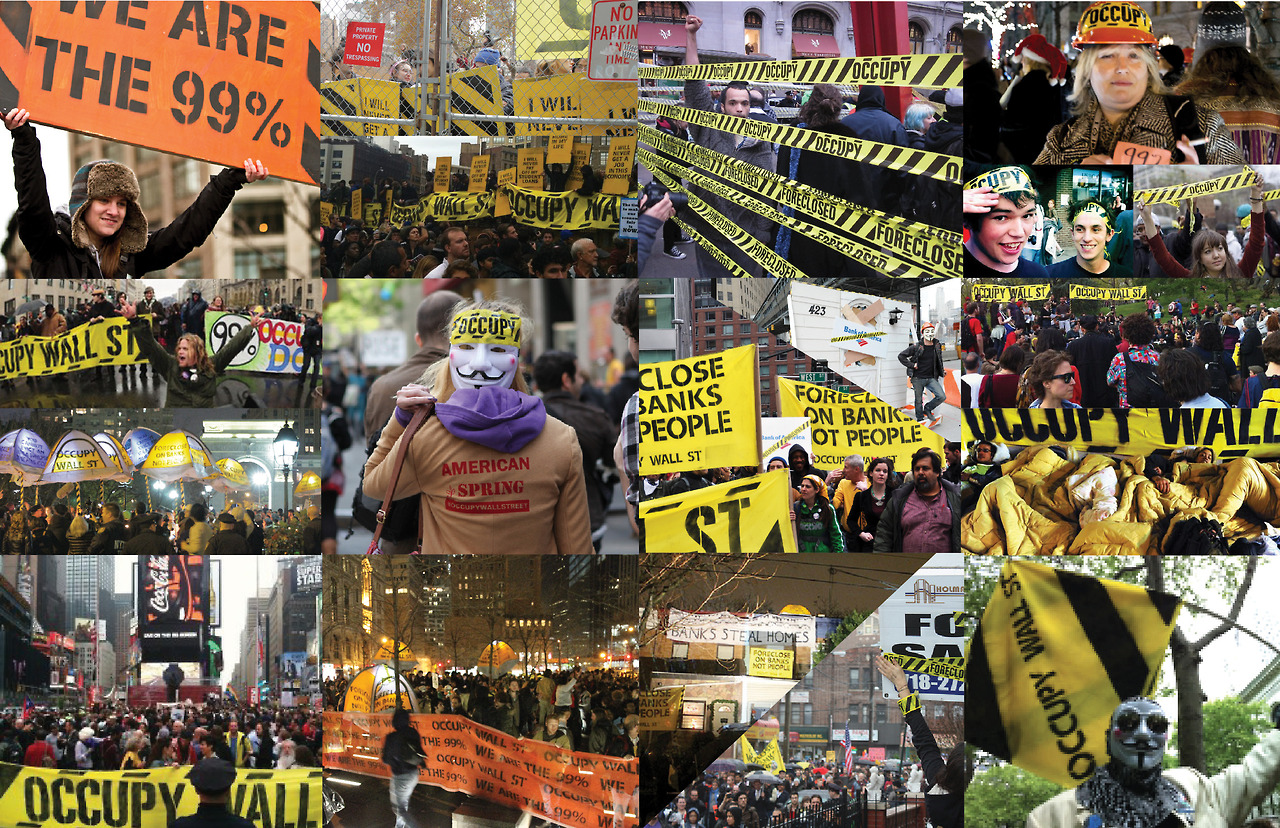
A contradiction is teased out on an old television set, found amidst garbage bags outside the front door. Flickering news reports implicate Tate Modern corporate sponsors Morgan Stanley, Bank of America, and Merrill Lynch in the housing bubble and ensuing economic crisis. The banks accrue reputational currency from their cultural sponsorship of the museum. But with this gesture their façade of social responsibility is cracked.
The television footage also depicts homeless people and activists responding to the crisis with tent cities, foreclosure defense teams, building occupations, and other forms of collective action.
Accompanying the installation will be literature for distribution featuring an essay by writer and filmmaker Astra Taylor, best known for her films Zizek! and Examined Life.